Back in 2009, the late great Joe Coggans successfully got a bylaw passed to require all flags purchased by the town be American made. It's the first thing I thought of after catching up with a recent Select Board meeting.
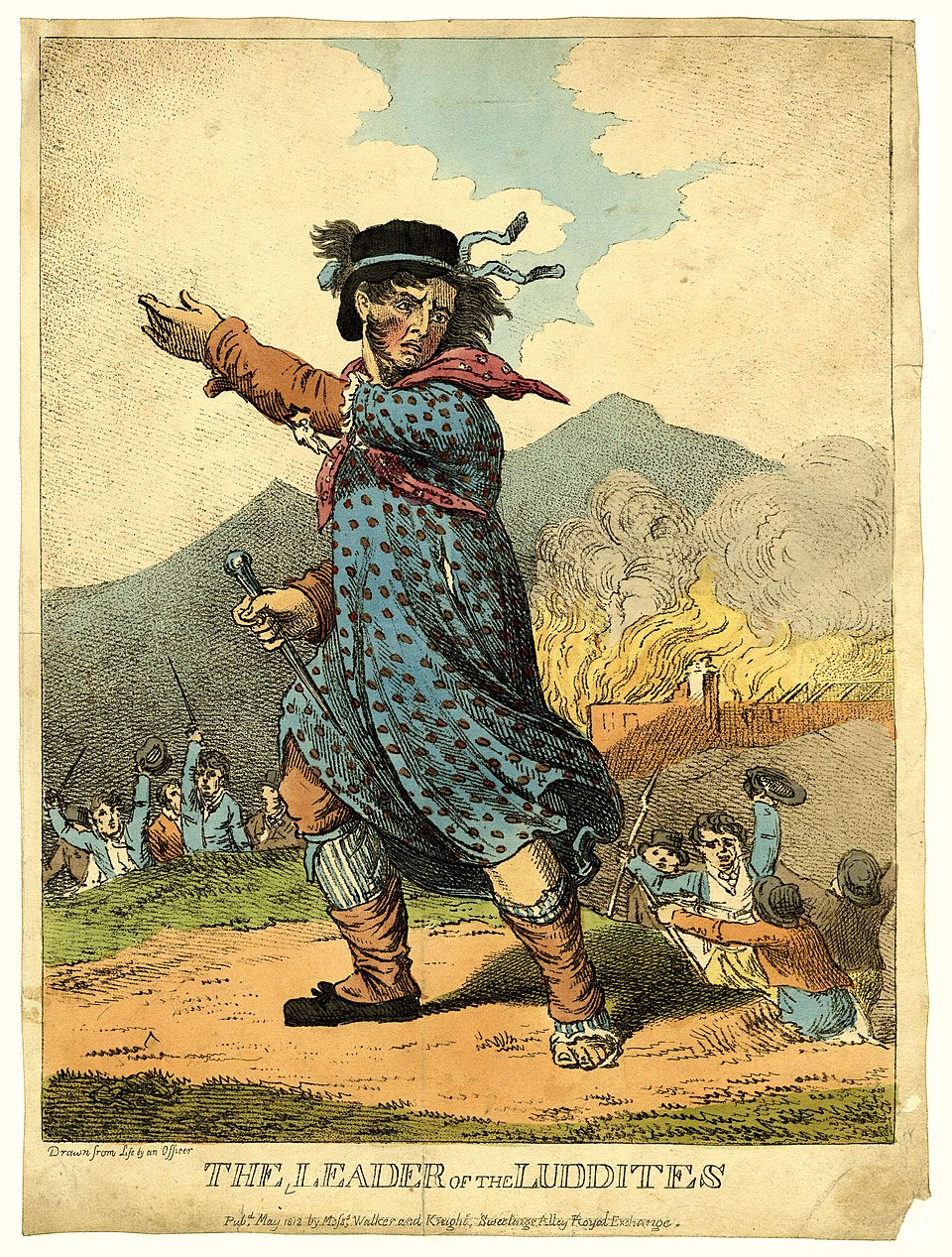
While the actual story is a lot more complicated than the popular one, legend is that in 1800s England, a group of textile workers revolted against the mechanization of much of their work. These people claimed to be inspired by "Ned Ludd," a young man who smashed some knitting frames or destroyed some needles, in a fit of rage. This sort of machine-smashing inspiration became synonymous with a resistance to modern technology, despite its roots as a pro-worker movement.
I am pretty far from a Luddite. I have my various love affairs with technology (despite the rampant enshittification across the industry), and I think we're by and large better off overall. I don't want to say "AI is different," but... well, AI is different.
I will say this much: I'm about as centrist as one can get on AI. I'm not convinced it's completely useless and see a number of potential uses for it that could truly be transformative, whether for disability access or to level the playing field where a true skill gap might exist. On the other hand, my interactions with the tools have been almost completely negative. On a personal level, I am an old dog that can't learn new tricks and I'm not really willing to invest a lot of energy into crafting the "right prompt" to get the AI to do something if I can just learn to do it myself. On a professional level, as someone who legitimately writes for a living, seeing what ChatGPT in particular has done to a lot of my professional tools is breathtaking in its destructiveness.
The conversation about AI is wrought, as well. The good these chatbots can do often, and rightly so, gets overshadowed by the tendency to encourage suicide, create child sexual abuse materials, engage in anti-semitism and racism, and more. Some of AI's harshest critics consider the mere existence of the technology as plagiarism (since the large-language models were trained on copyrighted texts, images, and videos) and as an environmental nightmare (since the data centers use so much energy to compute and so much water to stay cool).
(It also stole the em dash from us, which is a criminal act in and of itself.)
For me, beyond all the drawbacks above, I generally dislike AI for three main reasons: a) it doesn't work right for what I might potentially use it for, b) the prose and text it generates feels hollow and samey, and c) the aesthetic for visual art is uncanny valley at best and just gross at worst. This is not universally true, of course–some music style parodies are quite fun, as an example–but I don't think we actually need AI for this sort of stuff.
This brings me to Millbury. I was alerted to the January 27, 2026 Select Board meeting in the midst of my trying to play some catch-up. At approximately minute 50 of the meeting video, we get a presentation from new Town Planner Victor Panak regarding the Downtown Millbury banners you see on the telephone poles. Traditionally, those have been used to fundraise for the Downtown Beautification efforts or Chain of Lights, depending on the season, and they are kind of a big deal in many circles.
At the meeting, Panak and Town Manager Karyn Clark both noted how excited they were about the efforts this year, which will also celebrate the 250th birthday of the United States in tandem with various local celebrations. According to Panak, five designs were created and distributed to town employees, and the three favorites will go to the town to "democratize" the process. Those three, though?
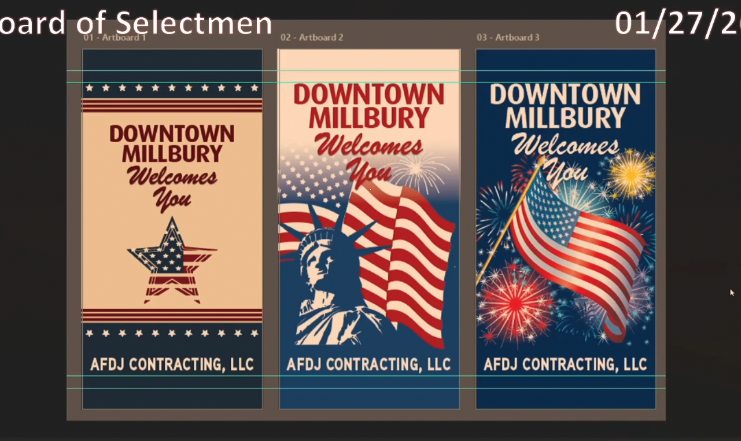
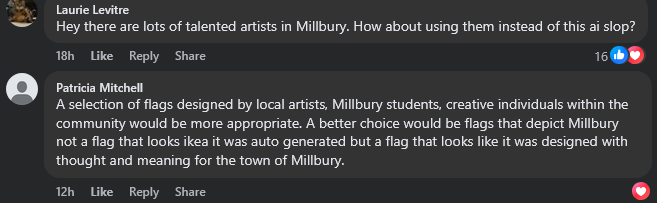
I wanted to be gentle about this, but my first reaction was that these are almost definitely AI generated. While the leftmost image does not immediately show any of the hallmarks of artificial intelligence, the center image has the stripes on the American flag wrong, and the rightmost depicts a flag that appears to get wider toward the bottom of the fabric. To its credit, the stars appear to be correct from this viewpoint, but the image quality on this is not good enough to be certain. Long and short, it sure looks like AI, and I'm not the only one who sees it:
The Planning Department would not be the first to use AI in public-facing endeavours, to be clear. While I haven't ever kept a log of them all, I know of a few boards that have relied on these tools in the past for their own publicity; this is the first time, however, that I've noticed it being used in an official capacity for town-sponsored activities.
I reached out to Panak on the issue, and he got back to me with some good, candid information: yes, they used an outside vendor due to time constraints, and he confirmed with said vendor that they did not develop these using AI. Town Manager Clark also followed up with me with some additional information regarding municipal AI use. I have no reason to believe either of them are lying, and I am not going to call out a small business for designs that I dislike if they, too, are confirming that they did not use AI.
So this was a lot of smoke, but no fire, thankfully. We can enjoy whatever ends up going on the banners without feeling like we're giving in on a semi-controversial technological outcome. That doesn't mean we can't take a lesson from it.
To be clear, the Coggans American flag thing was rather silly, and I'm not even convinced it was enforceable if it was ever enforced to start. But it is a template: we could very well require government-level creative-facing work products to not use artificial intelligence, or at least bar the worst offenses from use in municipal activities. I'm not sure, however, whether the hunger for such a rule is there or if a Coggans-level personality would be willing to take it up. God knows the fact that I'm even wading in these waters probably poisoned any chance of reform well before we even began digging...
So where does this leave us? A banner is relatively harmless in the grand scheme of things, putting aside the fact that a local artist is out a few hundred bucks. My concern is what happens if municipal AI use becomes more widespread. How do we ensure tools are used in a secure way, especially given that they handle a lot of sensitive personal information about the residents it serves? Are they using it to craft bylaws and policies when it's prone to hallucination? Who bears responsibility when (not if) the AI messes up?
Unless AI is indeed a bubble that's about to burst, the technology isn't going anywhere. God knows you can't write an email or visit a website without being offered a chatbot, if not having a useful tool destroyed by it. I don't use it, I know others do, but I think we should all at least expect that we are represented by humans on our boards and committees and that our town officials and employees are, in fact, acting as a human element in their administrative activities. And on a personal level, I would like to know that local government is perhaps the one place I can interact without fear of my data or information or critical aspects of my life are handed off to a software program that operates without us truly knowing how.
Unfortunately, this probably won't be the last time we are forced to face this issue in municipal activities, but if anything, I hope something as relatively low-importance as fundraising banners is the last time we have to have this conversation, instead of something potentially more consequential.
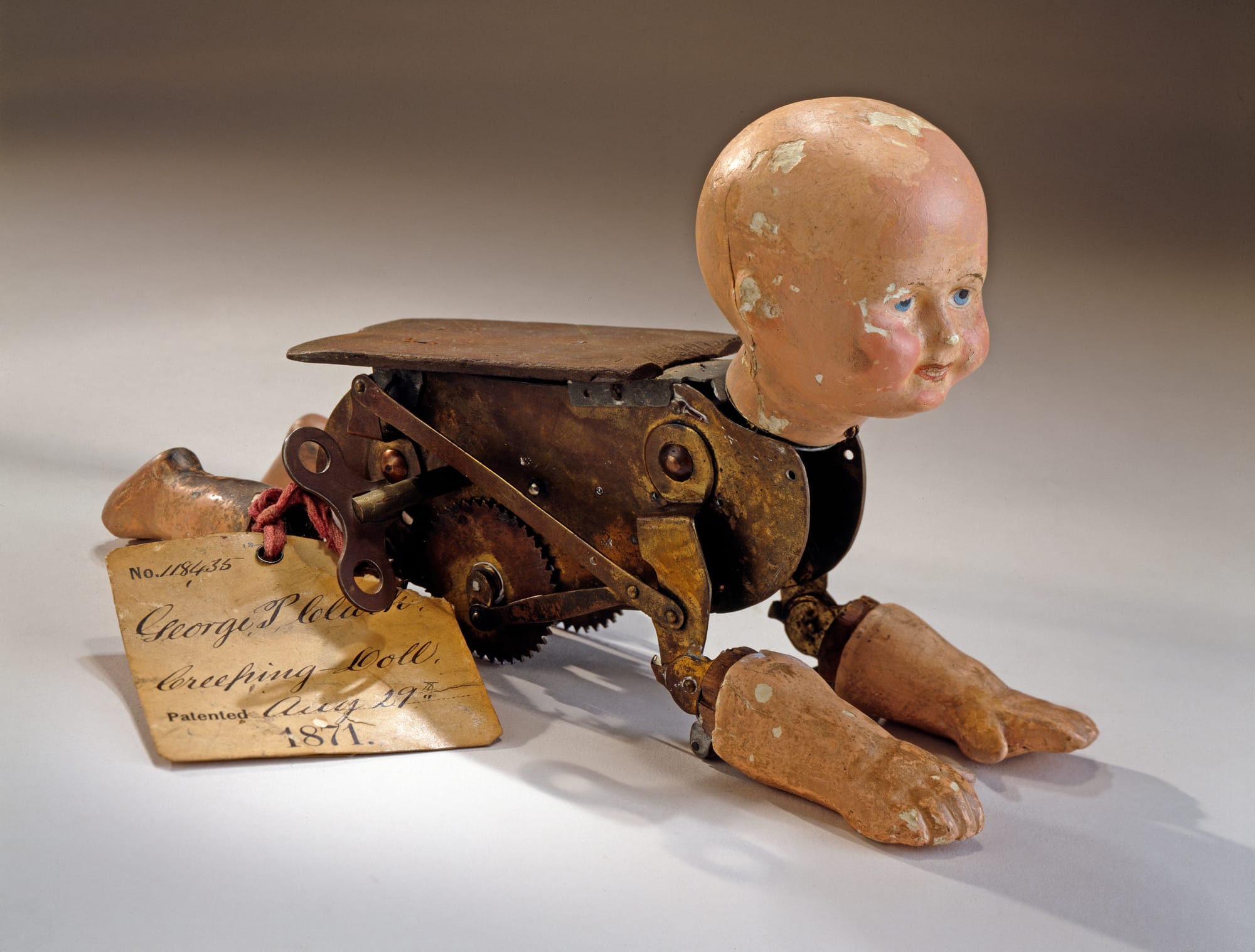
Postscript: When I post one of these, I generally hop on Smithsonian Open Access, who offer tens of thousands of images (including portraits and artwork) free to use in any capacity (and not AI generated), for the header picture. In searching for an appropriate image for this missive, however, I was introduced to this monstrosity. If I had to experience this nightmare fuel, so do you.
Jeff Raymond is a 40-plus year resident of Millbury and loves the town even if it doesn't always love him back. He is ready for winter to be over, because it's too cold gosh darn it. He is not really on Facebook, so find him at jeff.raymond@bramanvilletribune.com or BlueSky (@jeff.masstransparency.org)
Member discussion: